
Fear is one of the most common human emotions. Whether it is fear of failure, fear of loss, fear of rejection, fear of uncertainty, or even fear of death, everyone experiences it at some point in life.
While modern approaches often focus on managing fear, the Bhagavad Gita goes deeper—it teaches us how to understand the root cause of fear and ultimately transcend it.
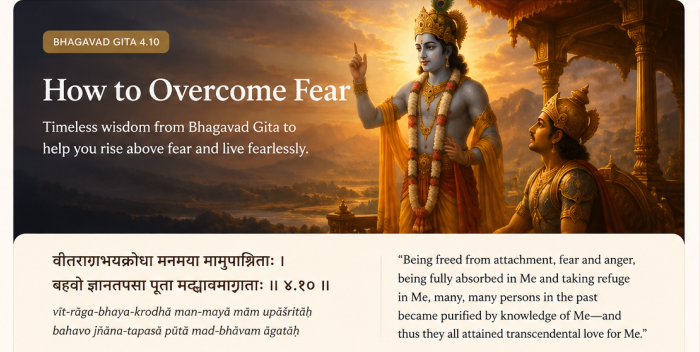
In Bhagavad Gita 4.10, Lord Krishna reveals a profound formula for becoming free from fear:
This verse not only identifies fear as a symptom of material consciousness but also provides a practical path toward fearlessness.
1. Why Does Fear Appear?
Fear does not arise randomly. It is usually a result of our attachments, misconceptions, and uncertainty about our true identity.
A. Fear Comes from Attachment
Whenever we become attached to something, we naturally become afraid of losing it.
Examples:
- Attachment to wealth creates fear of financial loss.
- Attachment to reputation creates fear of criticism.
- Attachment to relationships creates fear of separation.
- Attachment to the body creates fear of disease and death.
The stronger the attachment, the stronger the fear.
Fear is often the shadow of attachment.
B. Fear Comes from Misidentification
The Bhagavad Gita explains that we are eternal souls, but most of us identify ourselves primarily with the temporary body.
When we think:
- “I am this body”
- “I am my job”
- “I am my social status”
- “I am my possessions”
then every threat to these temporary things becomes a source of anxiety.
A person who forgets his eternal nature naturally becomes fearful because everything material is temporary.
C. Fear Comes from Lack of Control
Many situations in life are beyond our control:
- Economic changes
- Health issues
- Natural disasters
- Other people’s decisions
The mind becomes fearful when it tries to control things that are inherently uncertain.
D. Fear Comes from Forgetfulness of God
When we feel alone in facing life’s challenges, fear grows stronger.
A child feels secure when holding the hand of a loving parent. Similarly, when we forget our relationship with the Supreme Lord, we feel isolated and vulnerable.
2. What Does Bhagavad Gita Tell Us About Fear?
Bhagavad Gita 4.10 provides four powerful principles for overcoming fear.
1. Become Free from Attachment (Vīta-rāga)
Lord Krishna begins by saying that many great souls became free from attachment.
This does not mean abandoning responsibilities.
Rather, it means:
- Using everything in the service of God.
- Understanding that everything belongs to the Supreme.
- Accepting gain and loss with maturity.
When attachment decreases, fear naturally weakens.
Reflection
Ask yourself:
“What am I most afraid of losing?”
Your answer often reveals your deepest attachment.
2. Take Shelter of Krishna (Mām Upāśritāḥ)
Krishna states that those who became fearless took shelter of Him.
Taking shelter means:
- Trusting divine guidance.
- Depending on God’s wisdom rather than only our own intelligence.
- Understanding that Krishna is always protecting and guiding His devotees.
When a person knows that the Supreme Lord is caring for them, fear gradually gives way to faith.
Reflection
Instead of asking:
“What if everything goes wrong?”
Ask:
“How can I remember Krishna in this situation?”
3. Become Absorbed in Krishna (Man-mayā)
Fear thrives in a mind constantly absorbed in worries.
Krishna recommends a different absorption:
- Hearing about Him
- Chanting His names
- Remembering His teachings
- Serving Him
A mind absorbed in divine thoughts becomes less vulnerable to anxiety.
Just as darkness disappears when light enters a room, fear diminishes when the mind is filled with spiritual consciousness.
Reflection
Where is your mind spending most of its time?
On problems—or on the Supreme Problem Solver?
4. Purify Yourself Through Spiritual Knowledge (Jñāna-tapasā)
The verse explains that many people became purified through the “austerity of knowledge.”
Spiritual knowledge acts like a fire that burns ignorance.
Knowledge teaches us:
- I am not the body.
- I am an eternal soul.
- Krishna is the Supreme Controller.
- Everything happens under divine supervision.
- My real success is spiritual growth.
As this understanding deepens, fear loses its foundation.
Reflection
Many fears disappear when we gain proper knowledge.
Spiritual knowledge removes the greatest ignorance—the belief that we are merely temporary material beings.
3. Action Items to Come Out of Fear
The Bhagavad Gita does not stop at philosophy. It encourages practical transformation.
Here are five daily practices you can begin immediately.
Action 1: Identify Your Fear
Take a notebook and write:
- What am I afraid of?
- Why am I afraid?
- What attachment is connected to this fear?
Awareness is the first step toward freedom.
Action 2: Read Bhagavad Gita Daily
Spend at least 10–15 minutes every day reading Bhagavad Gita.
Even one verse daily can gradually transform your perspective.
Knowledge weakens fear.
Action 3: Practice the Mahā-mantra Meditation
Chant:
Hare Krishna Hare Krishna
Krishna Krishna Hare Hare
Hare Rama Hare Rama
Rama Rama Hare Hare
When the mind becomes fearful, redirect it toward Krishna through chanting.
A calm heart develops through spiritual connection.
Action 4: Focus on What You Can Control
Instead of worrying about future outcomes:
- Perform your duty sincerely.
- Leave the results to Krishna.
Fear often comes from trying to control what is beyond our control.
Action 5: Develop Faith Through Association
Spend time with spiritually minded people.
Association influences consciousness.
Hearing from devotees, spiritual teachers, and authentic scriptures strengthens faith and weakens fear.
Final Thoughts
Fear is not merely an emotional problem—it is often a spiritual signal.
It reminds us that we are seeking security in temporary things.
Bhagavad Gita 4.10 teaches that freedom from fear comes through:
- Reducing attachment
- Taking shelter of Krishna
- Absorbing the mind in Him
- Gaining spiritual knowledge
Many great souls followed this path before us and attained peace, purity, and divine love. Krishna assures us that the same path remains open today.
The journey from fear to fearlessness begins with a simple decision:
Turn your attention from what you may lose to the One you can never lose—Sri Krishna.